
LATEST NEWS
July 11, 2026
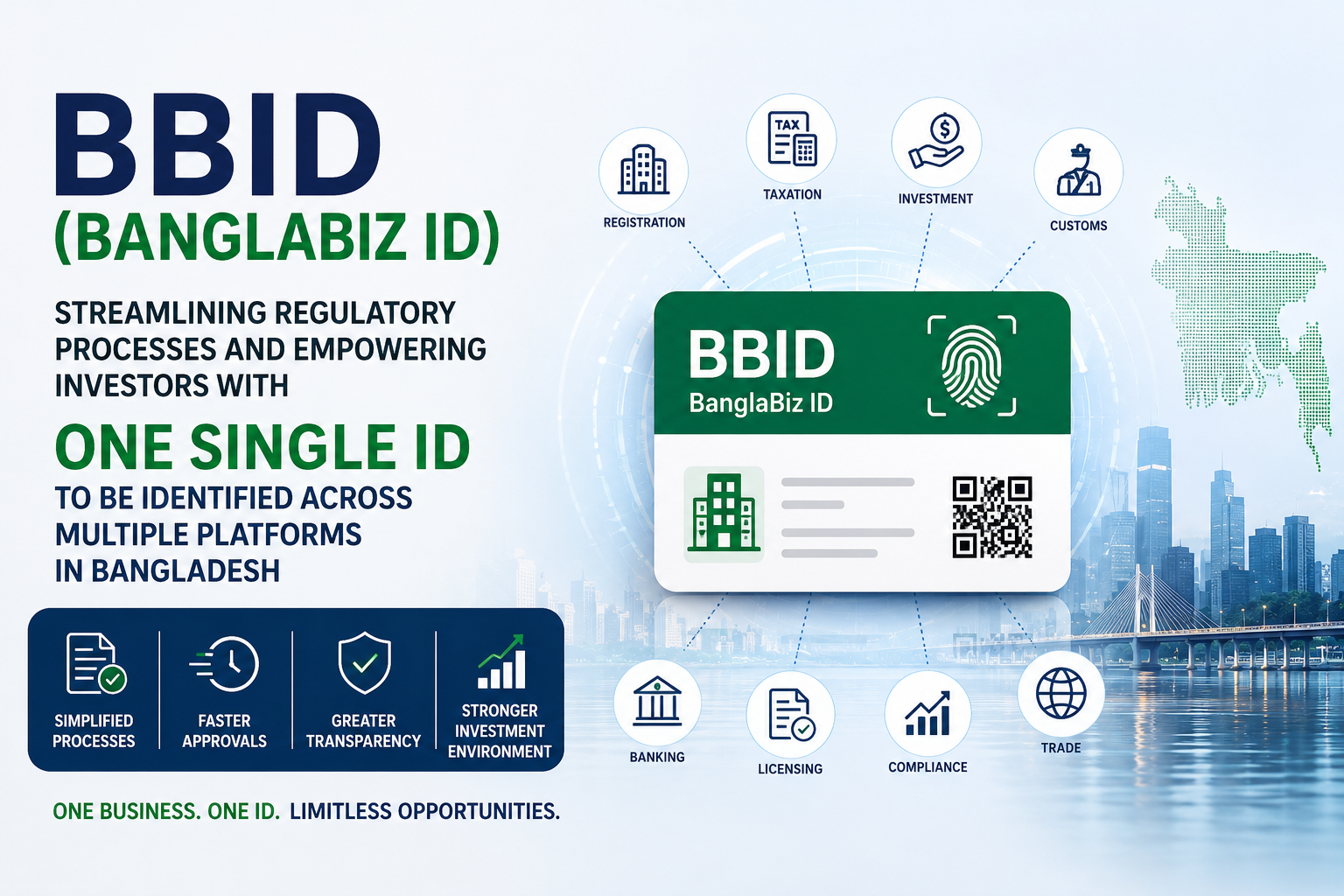
Bangladesh is rapidly transforming into one of South Asia's most promising investment destinations. As the country continues to digitalize government services and improve the ease of doing business, one of the most significant reforms on the horizon is the introduction of BBID (BanglaBiz ID)—a unified business identification system designed to simplify regulatory compliance and enhance investor experience.
The concept is straightforward yet transformative: one business, one identification number, accepted across multiple government agencies and digital platforms.
This initiative has the potential to redefine how businesses are established, regulated, and managed in Bangladesh.
BBID (BanglaBiz ID) is envisioned as a single, unique business identification number assigned to every registered business operating in Bangladesh.
Instead of obtaining and maintaining separate identification numbers for different government authorities, businesses would use one unified identity throughout their business lifecycle.
The BBID would serve as the primary digital identifier connecting a business with various regulatory, tax, licensing, banking, customs, investment, and compliance systems.
In simple terms:
One Business. One Identity. Multiple Government Services.
Currently, businesses often interact with numerous government agencies during incorporation and operation.
Depending on the nature of the business, companies may require registration or interaction with authorities such as:
National Board of Revenue (NBR)
Bangladesh Investment Development Authority (BIDA)
Bangladesh Bank
Customs Authorities
City Corporations
Local Government Authorities
Trade License Issuing Authorities
VAT Authorities
Import Registration Authorities
Export Registration Authorities
Industry-specific regulators
Each institution maintains its own database, registration process, and identification system.
This fragmented approach can create:
Duplicate information submission
Increased compliance costs
Administrative delays
Data inconsistencies
Lengthy approval timelines
Difficulties in inter-agency coordination
BBID aims to address these challenges through a centralized business identity.
Imagine a foreign investor incorporating a company in Bangladesh.
Instead of repeatedly submitting identical corporate information to multiple authorities, the investor would register once and receive a BBID.
The BBID would then allow government agencies to securely retrieve verified business information through integrated digital platforms.
This would significantly reduce paperwork and improve efficiency.
Potential benefits include:
Faster company incorporation
Simplified licensing procedures
Reduced document duplication
Better data accuracy
Improved transparency
Enhanced regulatory coordination
One of the strongest advantages of BBID is interoperability.
A unified identifier could potentially connect with:
Company registration systems
Tax administration
VAT registration
Customs systems
Banking compliance
Investment approvals
Digital payment systems
Government procurement
Trade licensing
Business permit renewals
Businesses would no longer need to remember multiple registration numbers issued by different authorities.
Instead, BBID would become the central reference point.
Foreign investors often evaluate countries based on regulatory efficiency.
Lengthy registration procedures and multiple government touchpoints can discourage investment.
BBID could substantially improve Bangladesh's investment climate by offering:
Investors could complete regulatory formalities more efficiently using one unified business identity.
Integrated databases reduce inconsistencies and improve confidence in regulatory information.
Less duplication means fewer administrative expenses.
Digital verification enables agencies to process applications more quickly.
Businesses spend less time on paperwork and more time on growth.
BBID is equally valuable for domestic entrepreneurs.
Small and medium-sized enterprises (SMEs), startups, manufacturers, exporters, and service providers would benefit from:
Easier business registration
Simplified renewals
Reduced compliance burden
Improved access to government services
Better integration with digital platforms
Increased operational efficiency
For SMEs, reducing administrative complexity can have a significant impact on business growth.
Bangladesh has made remarkable progress in digital governance over the past decade.
The implementation of BBID would complement ongoing initiatives aimed at:
Digital government services
Smart regulation
Online licensing
Digital tax administration
Electronic payments
Data-driven governance
A unified business identity strengthens digital infrastructure while enabling better policy planning and regulatory oversight.
Government agencies frequently require access to similar business information.
BBID could facilitate secure data sharing among authorized institutions while reducing repetitive verification processes.
Improved coordination may result in:
Faster approvals
Reduced administrative duplication
Better compliance monitoring
More accurate business statistics
Enhanced policy development
Regulatory compliance should protect public interests without creating unnecessary obstacles for businesses.
BBID offers an opportunity to modernize compliance by making regulatory processes:
Simpler
Faster
More transparent
Digitally integrated
Less resource-intensive
Businesses remain accountable while administrative procedures become significantly more efficient.
Beyond registration, BBID could become the foundation for a wide range of digital business services.
Future possibilities may include:
Digital business profiles
Electronic compliance certificates
Integrated licensing dashboards
Online permit renewals
Cross-agency status tracking
Digital document verification
Secure electronic authentication
Such innovations would help create a more connected and investor-friendly business ecosystem.
Many developed and emerging economies have adopted unified business identification systems to improve public administration and encourage investment.
These systems generally aim to:
Eliminate duplicate registrations
Improve regulatory efficiency
Facilitate digital government services
Enhance business transparency
Support economic growth
By embracing a similar approach, Bangladesh can further align itself with global standards in digital governance and investment facilitation.
While the benefits are substantial, implementing a nationwide unified business identification system requires careful planning.
Key considerations include:
Secure data governance
Cybersecurity safeguards
Inter-agency system integration
Legal and regulatory harmonization
Data privacy protection
Capacity building
User awareness and training
Strong institutional coordination will be essential to ensure successful implementation.
As Bangladesh advances toward becoming an upper-middle-income economy, regulatory modernization will play a vital role in sustaining economic growth.
BBID represents more than a new identification number—it symbolizes a shift toward a digital-first, investor-friendly, and integrated regulatory environment.
A single business identity has the potential to reduce complexity, improve transparency, strengthen compliance, and create a more seamless experience for entrepreneurs and investors alike.
BBID (BanglaBiz ID) has the potential to become one of Bangladesh's most impactful business reforms by replacing fragmented identification systems with one unified business identity accepted across multiple government platforms.
For entrepreneurs, it means fewer administrative hurdles. For investors, it offers greater certainty and efficiency. For regulators, it enables smarter governance through integrated digital systems.
As Bangladesh continues its journey toward a more digital and investment-friendly economy, BBID could serve as a cornerstone of modern business administration—making it easier to establish, operate, and grow a business with one single ID, one streamlined process, and one connected ecosystem.
Disclaimer: This article is intended for general informational purposes only. The features and implementation of BBID (BanglaBiz ID) will ultimately depend on the legal framework, regulatory policies, and operational guidelines adopted by the Government of Bangladesh. Businesses should seek professional legal or regulatory advice before relying on any future implementation of the BBID system.
 Chat
Chat